
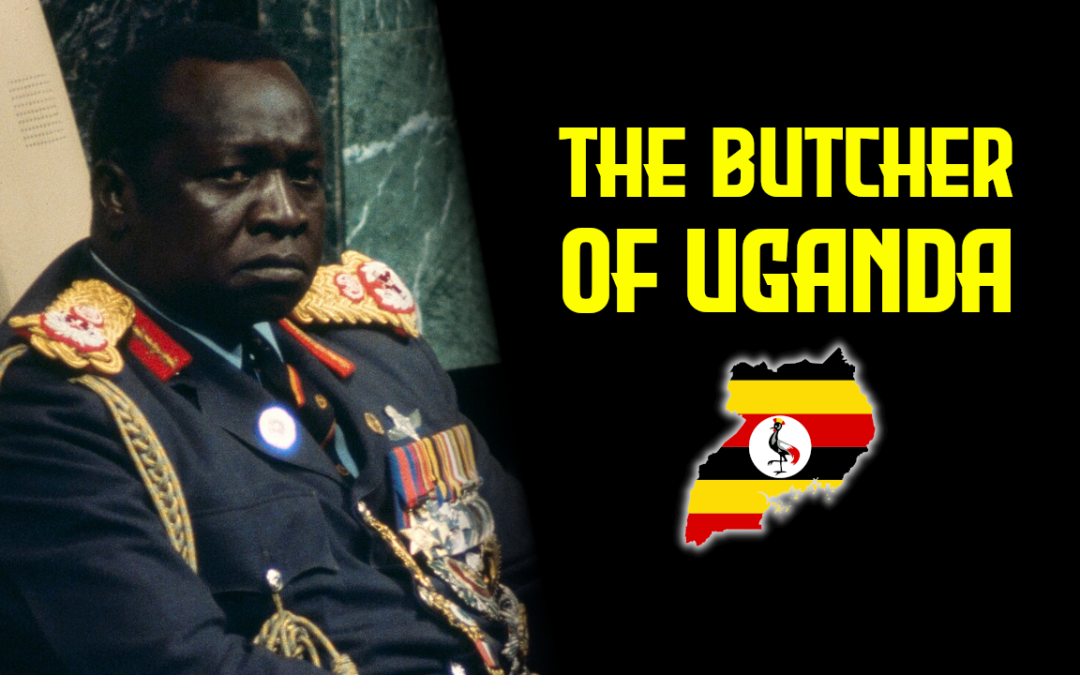
Few tyrants are as infamous as Idi Amin Dada Oumee. To the outside world he was a clown. A cartoonish figure more known for his funny dancing than anything else. But to the people of Uganda he was a brutal despot. A cruel and violent man who single handedly dragged their nation into ruin. He held power for slightly over 8 years, ruling over Uganda for the bulk of the 1970s. During that time, he amassed a fortune of millions of dollars, and earned the nickname “The Butcher of Uganda”. But there is so much more to this man than the shocking headlined. So much more than the cliff notes of his life. And so, we count down the ten most wild facts about Idi Amin.
10 He Had Dozens of Children
Where better to begin our list of facts about Idi Amin than with the miracle of fatherhood. A dictator having a lot of children is nothing unheard of, but this man really pushed the limit. Nothing was ever enough for Idi Amin. No amount of political power could satisfy him. No amount of fame or respect, or even money and goodies. Nothing. So too was this true in his romantic life. Working his way through a succession of at least six wives, Amin fathered dozens of children. The true number is not known, but there were at least 43 of them! Experts believe the real number to be closer to 60, though. The eldest of said children seems to have been born in 1955, and the last known to have been born in 1993.
9 He was A Champion Boxer
The man was a giant. Idi Amin stood 6 foot 4 inches tall, and was unusually athletic from a young age. Besides excelling at swimming, he was as strong as an ox, and tough as nails. Rugby was a passion and he took to it like a natural. But swimming and rugby were merely stepping stones in his athletic career. It was only a matter of time before he got into boxing. Little detail is now known about Idi Amin’s boxing career. Only that he boxed as a youth while serving in the military. Surpassing this, he rose to be the Ugandan light heavyweight boxing champion. The absolute beast of a man ended up holding the title for nine long years, between 1951 and 1960.
Amin would actually attempt a return to boxing while in power, when he challenged Muhammad Ali to a fight. Given the natural reluctance to fight a brutal dictator in their own country, Ali politely declined the offer. While this was clearly a decision of diplomacy, it remains a fact that Muhammad Ali backed down from a fight with Idi Amin.
8 He Made Use of Magic
You’d be surprised how many dictators believed in magic and the supernatural. There was the insane Haitian ruler François Duvalier who concerned himself deeply with voodoo. The Burmese dictator Ne Win was likewise concerned with the unseen, often making government decisions on the advice of astrologers. Idi Amin’s belief in magic pales in comparison to these contemporaries. But it remained an important part of his mindset. Perhaps there was truth to the rumour that his mother became a witch doctor. Or perhaps he merely viewed it as a political tactic. Either way, Idi Amin was known to attend all manor of folk rituals conducted by traditional witch doctors.

7 He Was Obsessed With Scotland
One of the most well known facts about Idi Amin regards his obsession with Scotland, the small Western European nation. It’s the kind of obsession that would be endearing if not for the brutality of the man who held it. Amin engaged in Scottish culture at every given opportunity, wearing kilts and learning to play the bagpipes. He even named some of his children after traditional Scottish Clans. Most outrageous of all, though, was declaring himself to be the king of Scotland. It is unclear precicely why Scotland loomed so large in Amin’s mindset. The main theory is that he served under a kind Scottish officer while a youth in the colonial African forces. Either way, it is partly why people outside of Uganda tended to view him in a clownish light. That and the dancing.
6 He Was A Fruitarian
One of the more widely believed rumours about Idi Amin was the claim he was a cannibal. There is no evidence to prove this, and most today believe it to be little more than lazy political propaganda spread by his enemies. But it’s easy to understand why people found it so believable. After all, he was known as the Butcher of Uganda. What might shock you, however, is that this brutally violent man eventually took on a fruitarian diet. That’s right, in his final years he swore off meat and ate only fruit. In fact, he got into the habit of eating 40 oranges a day! This gave birth to another of his many nicknames. This time the more innocent sounding Dr Jaffa.
5 He Invaded Tanzania
The downfall of countless dictators has been hubris, something about unlimited power tends to change a person. You start believing your own propaganda. You buy into the myth of destiny. Idi Amin believed his destiny was that of a conqueror. So in 1978 he mobilized the Ugandan military to invade Tanzania’s Kagera Region. Called home by more than two million people, Kagera was rich in fertile farmland, and would have greatly boosted the Ugandan economy. Amin argued it had historically been part of Uganda, and that he was waging a war of liberation. A just war. The world saw it differently, though, transforming Amin’s image from clown to tyrant.
None were more against the invasion than Tanzania. In order to reclaim Kagera, they mobilized 150 thousand men and geared up for a bloody battle. As Uganda had just 20 thousand, they were soon pushed back onto home soil. And it didn’t end there. Tanzanian troops poured across the border, facing little resistence as they secured city after city. Kampala would soon fall, taking the remnants of Idi Amin’s regime with it.

4 He Expelled Entire Demographics From Uganda
Among the overlooked facts about Idi Amin is that he genuinely believed god chose him to rule. The divine right to rule is nothing new, but by the mid 20th century, it really had fallen out of favour. Despite this, Idi Amin proudly boasted of his divine connection. In fact, he even claimed to be in regular communication with god. Perhaps the most infamous action he took on supposed divine advice came in 1972. In August of that year, Amin shocked the world by ordering the expulsion of Uganda’s minority Indian population.
At the time, roughly 80 thousand South Asian people lived in Uganda. Many of which were born and raised there and considered Uganda their home. But as a black supremacist, Amin saw little benefit to letting them remain. With many thousand businesses being owned by South Asians, he had an easy time branding them as evil foreigners exploiting the labor of native Africans. As part of the expulsion, assets like businesses and houses were confiscated. The argument was that such assets rightfully belong to black Ugandans. But it wasn’t so smooth, and Uganda’s economy immediately collapsed.
3 His Wife Was Murdered
Idi Amin is known to have had at least six wives, four of which at the same time. Apparently this was too much for him, though. In March of 1974 he decided to divorce 3 of said wives, leaving him with just his most recent, Nalongo. Among those divorced was Kay Adroa. Little detail is known of her personal life, but just five months later she was brutally murdered. The corpse was discovered in the trunk of a car, a car belonging to a local doctor. According to the official story, the doctor had performed an abortion on Kay. But for some unclear reason, he panicked and murdered her, before poisoning himself.
2 His Official Title Was Wild
Dictators are not unknown to grand themselves grandiose official titles. It’s in keeping with the narcissism of one who would take power by force. But even among this ridiculous grouping of people, Idi Amin stands out. His self bestowed title went as follows:
“His Excellency, President for Life, Field Marshal Al Hadji Doctor Idi Amin Dada, VC, DSO, MC, CBE, Lord of All the Beasts of the Earth and Fishes of the Seas and Conqueror of the British Empire in Africa in General and Uganda in Particular”
1 He Got Away With It
Last in our list of facts about Idi Amin is how his story ended. There are only so many ways for the story of a dictator’s life to end. For most, they either die in office or end up in prison. For Idi Amin, though, there was no such justice. I mentioned before how his government fell as a result of his disastrous invasion of Tanzania. But while he was foolish enough to launch the invasion, he was not foolish enough to stick around when it went south. After briefly fleeing to a smaller city and declaring it the new capital of Uganda, he soon fled that too. To start with, it was Libya. Gaddafi had long been Amin’s strongest supporter, so it only makes sense for him to find refuge there. But Libya was unstable, and Amin was now being a deeply unpopular figure.
Ultimately, it was decided he would cause less trouble in Saudi Arabia. The Saudi’s offered permanent asylum to Amin. A generous, yet strict offer. The main condition was silence. He would no longer be allowed to be involved in politics of any kind. As a result, Idi Amin would spend the remainder of his life as a free man. A quiet life of safety in Saudi Arabia.